FASTT: Five Key Design Elements of Hybrid Collaboration Spaces
The way we work has changed, and collaboration and meeting spaces must change with it.
Today's hybrid workplace brings together all kinds of people: full-time office staff, part-time remote workers, and fully remote employees. Solving the meeting room problem is a key part of meeting today's employees' needs, and our workplaces face the challenge of adapting to new demands.
Why does meeting/collaboration space design need to change?
Workers are asking this question more and more, now that they have more control over where work gets done: "Could this meeting have been an email?" A well-planned meeting space makes it much easier to answer "no." The age-old question of "Why are we meeting?" can be clarified with the help of different types of spaces, several new seating options, dedicated project rooms, and greener locations.
To serve a globally dispersed workforce, meeting room design has to change. To enable hybrid work, collaboration spaces bridge the gap between the physical and the digital, allowing colleagues who are face-to-face and colleagues who are far away to interact, meet, brainstorm, discuss, and otherwise engage with one another.
FASTT — the five key elements of a successful collaboration space
Furniture, Ambiance, Suitability, and Technology & Tools: the five factors outlined below are the ones to keep in mind when designing efficient, successful meeting spaces for your office.
Furniture
Meetings tend to run long — and in uncomfortable chairs, they feel even longer. That's why the type of furniture you choose, and where you place it, is an important part of enhancing the overall experience of everyone in the office. Furniture and chairs should be arranged to suit the size of the room or space and to improve everyone's line of sight.
Tables with rounded or tapered edges allow the camera to see more people. Ergonomic chairs help people stay relaxed even in lengthy meetings. Comfortable lounge chairs or standing desks can encourage teams to brainstorm in smaller settings or informal meeting spots.
Ambiance
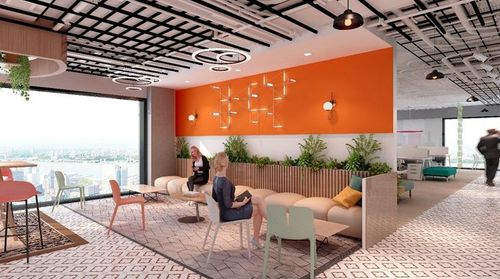
The ambiance of a meeting space has a considerable effect on people's mood and experience. Lighting, color, sound, and touch together create the overall atmosphere of a space.
The best lighting for video conferencing is natural, diffused light; avoid harsh lighting wherever possible. For video calls, a neutral background such as gray provides an ideal setting. Add as much sound-absorbing material to the space as possible to improve audio quality for both in-person and virtual guests. Finding ways to bring plants into meeting rooms is becoming a priority, because adding greenery to enclosed areas brings real benefits.
Suitability
For a hybrid staff, one-size-fits-all meeting rooms aren't enough. The first question to ask is: "What kinds of meetings should this room mainly support?" Depending on a team's needs and its size, hybrid spaces must be built to support a range of interactions and activities.
The relationship between meeting room features and room size is crucial to making sure all available meeting space is used effectively. If most attendees will be on a call, your meeting space should be designed differently. If meetings average only 3-5 in-person attendees, your company may benefit from fewer large meeting rooms and more small ones.
Tools
Hybrid meeting spaces also need analog tools. Consider equipping the space with practical collaboration tools that help participants work with remote colleagues. Magnetic and portable whiteboards are extremely useful for brainstorming sessions and team discussions.
Technology
If a hybrid collaboration space isn't equipped with the right technology, it simply won't work for a hybrid team. Nothing derails a meeting faster than poor audio. Poor video quality, insufficient power access, device-sharing problems, technical glitches and more... hybrid work comes with its own set of issues.
Consider using two flat screens — one to display the meeting content and one to display virtual attendees. Choose the right camera and position it according to the activities that take place in the space. So that every virtual participant can hear every in-person attendee well, the space should be covered by microphones. The right microphone for the environment improves sound quality while reducing noise. Power should be within easy reach of all participants on site. Consider hardware that connects smoothly with your software platform and tools to link shared devices.