
Office Chair Swivel and Height Adjustment
The swivel and height adjustment functions of office chairs are primarily achieved through the combination of a pneumatic height adjustment system, elastic brackets, and casters, representing a core design feature of modern office seating that significantly enhances comfort and flexibility.
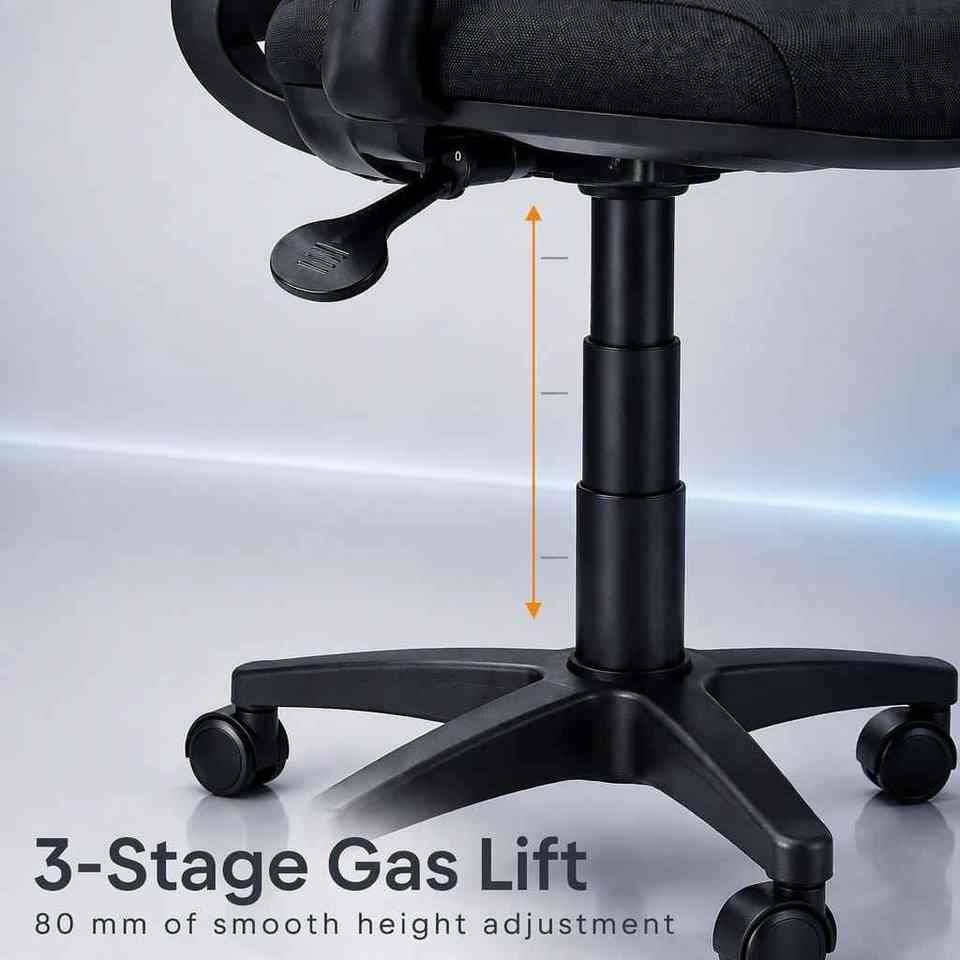
Implementation Principle of Swivel Function
The swivel function of office chairs relies on the elastic bracket and caster structure. The elastic bracket, typically made of high-strength metal or engineering plastic, connects the seat cushion to the five-star base. It incorporates a buffering mechanism (such as springs or dampers) inside to reduce friction and vibration during rotation, ensuring a smooth and stable turning process. The casters are mounted at the ends of the five-star base and come into contact with the ground through low-resistance bearings, supporting 360-degree free rotation while also allowing for position locking to prevent accidental movement. For example, some ergonomic chairs feature silent casters to minimize noise during rotation.
Implementation Principle of Height Adjustment Function
The core of the height adjustment function is the pneumatic height adjustment system, consisting of a pneumatic rod, control valve, and base. The pneumatic rod is filled with high-pressure nitrogen gas, and height changes are achieved by adjusting the gas pressure through the control valve: when the user presses the height adjustment button, the control valve opens, allowing gas to flow within the pneumatic rod and push the piston, thereby raising or lowering the seat cushion; when the button is released, the valve closes, locking the pneumatic rod at the current height to ensure stability. The adjustment range of the pneumatic rod is typically 10-15 centimeters, accommodating users of different heights. For instance, the pneumatic rod of the JD.COM Jingzao Z5 Pro ergonomic chair supports a 50mm adjustable backrest, allowing users to precisely adjust the support position according to their sitting posture needs.
Optimization of Ergonomic Design
Modern office chairs further integrate ergonomic principles, enhancing comfort through adjustable components. For example, 3D dynamic lumbar supports can be adjusted forward and backward as well as up and down, automatically conforming to the curvature of the waist to alleviate fatigue from prolonged sitting; the height adjustment function of the backrest (such as the 50mm adjustment range of the Z5 Pro) allows users to find the optimal support point based on the length of their back, avoiding excessive pressure on the lumbar spine. These designs extend the swivel and height adjustment functions beyond basic adjustments, enabling them to adapt to diverse body types and sitting postures.
Safety and Durability Assurance
The quality of the pneumatic rod directly affects the safety of the height adjustment function. High-quality pneumatic rods must pass international safety certifications (such as the BIFMA standard) to withstand frequent height adjustments and long-term pressure, avoiding explosion risks. The materials of the five-star base and casters (such as nylon or steel) determine the stability of rotation and movement, with high load-bearing designs ensuring reliability for users with larger body weights.


