Healthy Work Research: What Counts as a Proper Break Interval?

Prolonged sitting is a common behavior among office workers, its most visible symptom being a sedentary stillness. For people who sit for long periods, the spine stays in a deeply bent position for long, infrequent stretches rather than moving in small, regular ways, and the discomfort and bodily harm caused by prolonged sitting can take years — even decades — to become apparent. According to our previous research, 78.47% of people who work in offices for long hours also sit for long stretches. Standing up, stretching, and walking around during the workday are all ways to self-regulate and restore energy; even a short time can mean big psychological and physiological changes. A proper break interval interrupts your work without feeling like an interruption, while providing real relaxation. So how long is a "proper break interval"? We explored this from several angles:
1. Comfort across different break intervals
Changes in the break interval had a measurable effect on discomfort in different body parts. As the break interval got shorter, discomfort in the body's parts trended downward.
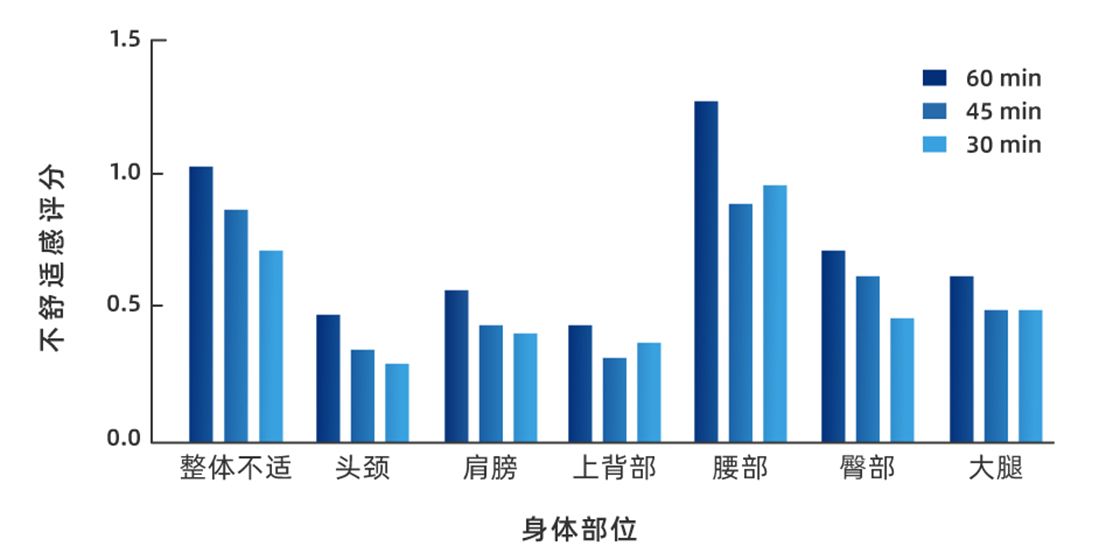
A 30-minute break interval produced the lowest overall discomfort and the lowest discomfort in most body parts. Clearly, 45-minute and 30-minute intervals relieve physical discomfort better than a 1-hour interval.
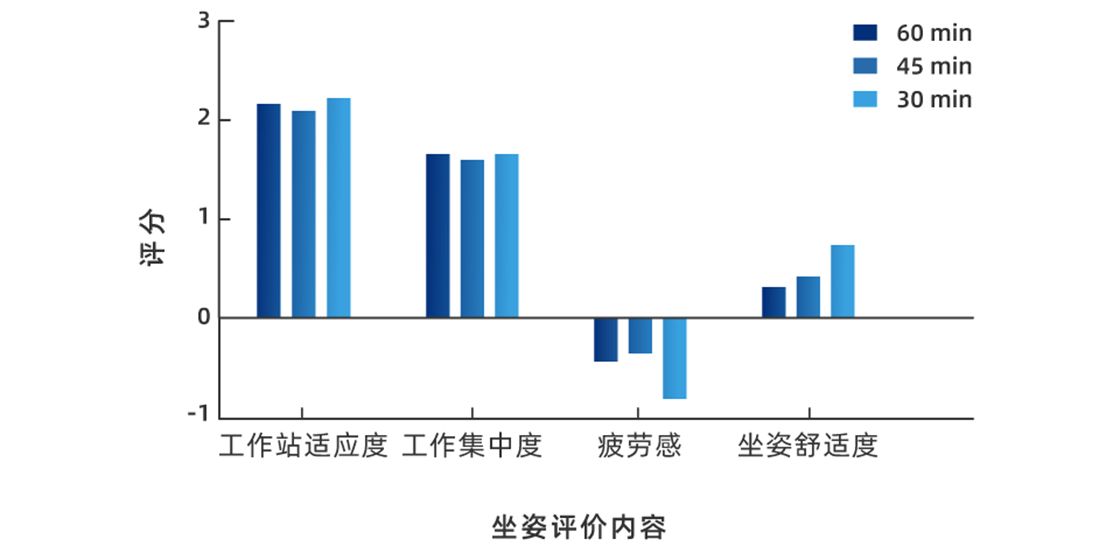
However, the three break intervals showed no significant effect on how well people adapted to their workstation or on their concentration at work. But fatigue did weaken as the break interval shortened, and seated comfort improved accordingly.

2. Number of body-pressure shifts
In past research, the Nanjing Forestry University–Yihang Furniture Human Factors Engineering Research Center found that the more often a seated posture changes, the worse the sense of postural stability, relaxation, and comfort, and the stronger the feeling of fatigue — which signals that discomfort has set in. Therefore, by looking at how different break intervals affect the number of posture changes, we can infer how break intervals affect fatigue.
Take the share of posture changes under natural sitting as an example:
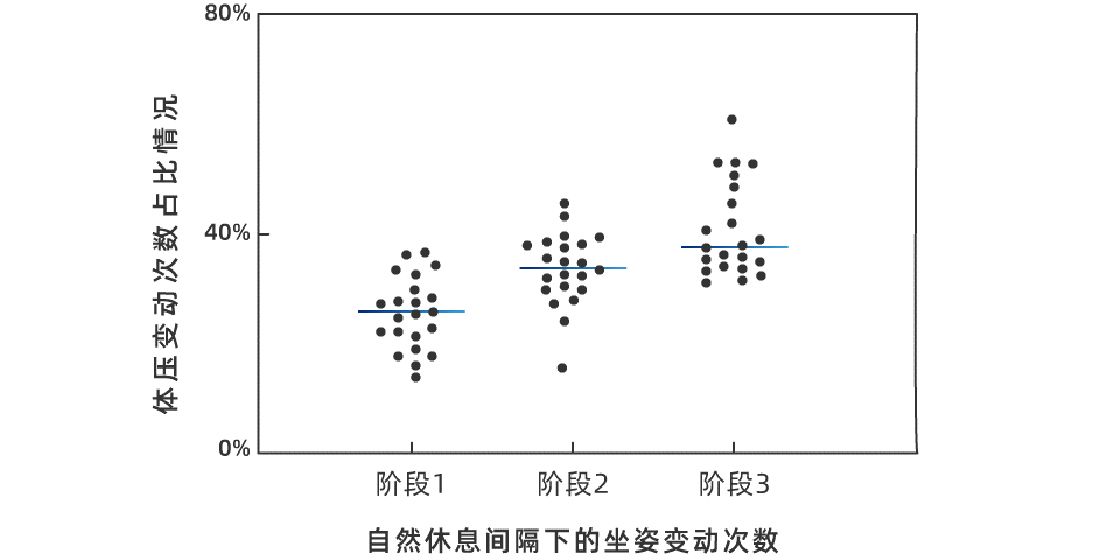
As you can see, during subjects' natural sitting, the number of body-pressure shifts rose steadily across the early, middle, and late phases of sitting. Combined with past research showing that a marked increase in posture changes usually signals discomfort, we analyzed the phase in which body-pressure shifts first increased significantly under each interval:
60 min:
Phase 1 (minute 20) to Phase 2 (minute 40)
45 min:
Phase 1 (minute 15) to Phase 2 (minute 30)
30 min:
Phase 2 (minute 20) to Phase 3 (minute 30)
Based on these results, we can infer that after about 20 minutes of continuous sitting, fatigue begins to build, seated comfort declines, and the number of posture changes — that is, body-pressure shifts — increases significantly.

3. Changes in calf swelling
Because prolonged sitting reduces blood flow to the lower limbs and causes them to swell, measuring leg swelling through changes in calf circumference lets us analyze the effects of long sitting.
The experiment showed that subjects under the 45-minute and 30-minute break intervals had the smallest change in calf circumference — in other words, milder leg swelling.
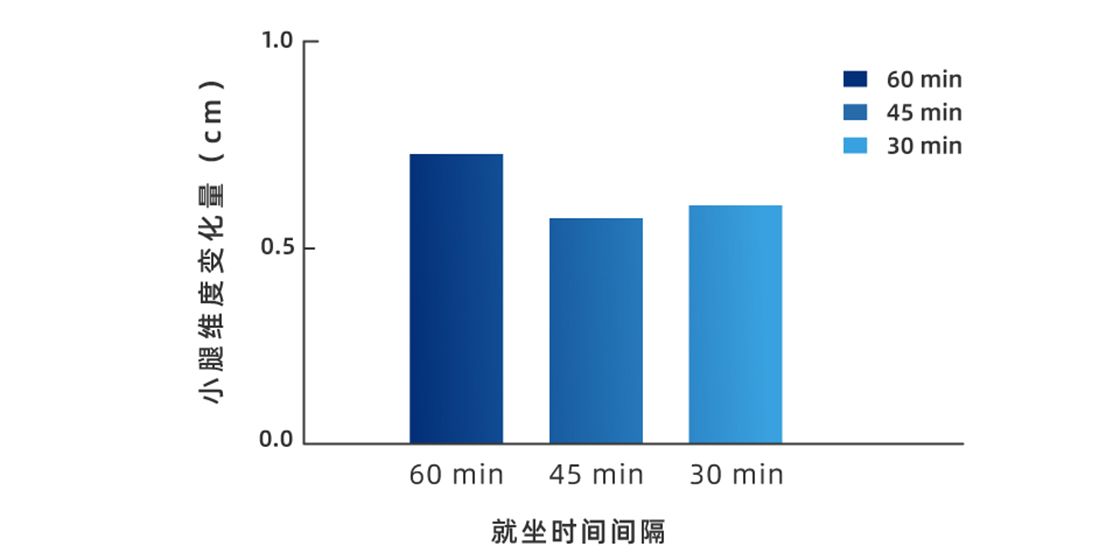
So 45-minute and 30-minute break intervals reduce leg swelling better than a 60-minute interval.

4. Subjects' subjective feedback
After the experiment, subjects' subjective impressions were collected via questionnaire. The questionnaire items and results are shown in the table below:
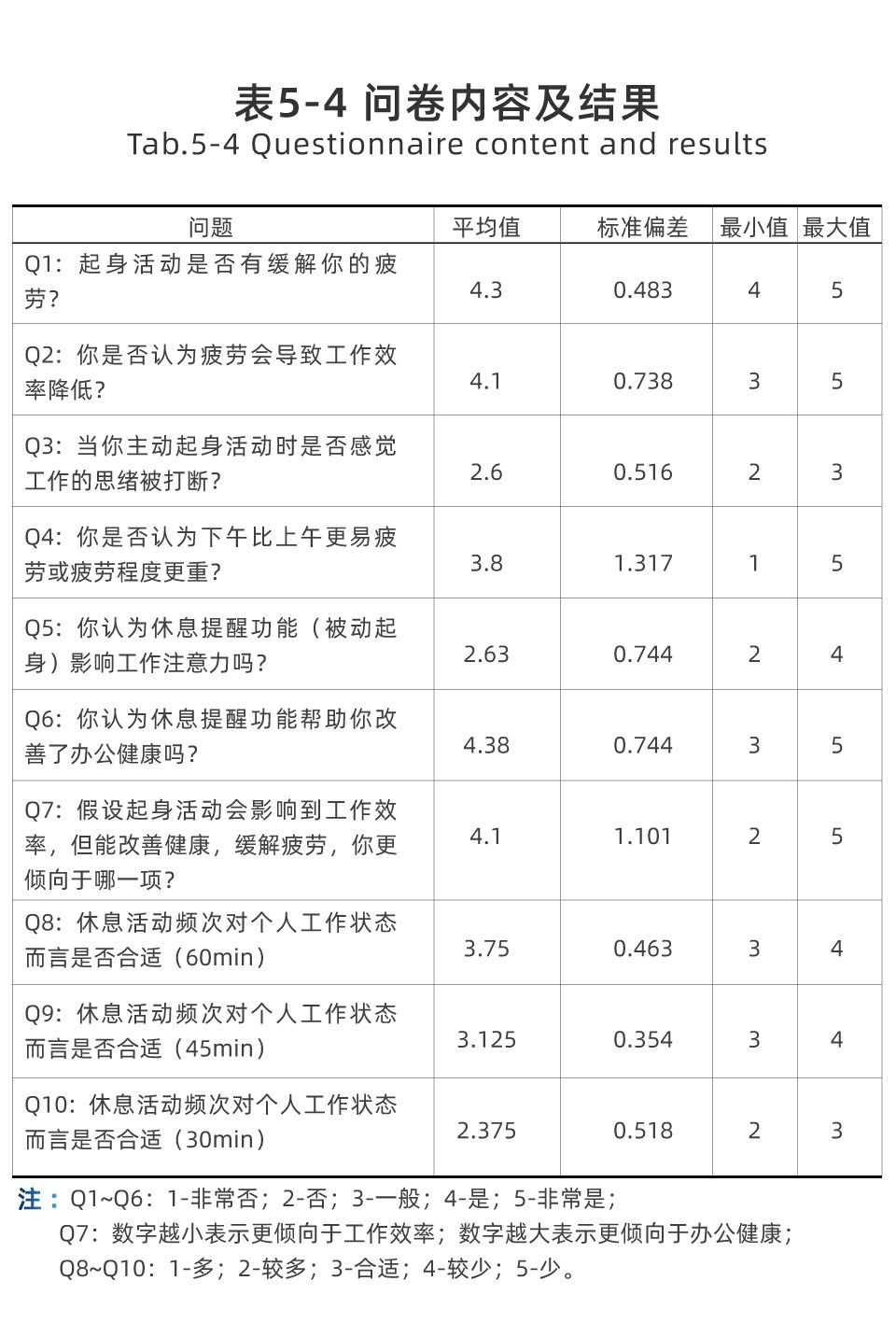
The findings: fatigue lowers work efficiency, but getting up and moving relieves it well. The vast majority of subjects felt that whether they got up to move on their own or were prompted by a break-reminder feature, their train of thought was not interrupted in a way that hurt efficiency. Subjects generally agreed that office health matters more, and the break-reminder feature felt like something that helps improve it. Subjects also generally found afternoons more tiring than mornings.
Comparing the sitting intervals, the vast majority felt 60 minutes was too long and 30 minutes too frequent, while a 45-minute interval was just right.

Bringing all of these findings together: although the 30-minute interval performed best on every measure, it made people feel they were getting up too often; a 45-minute interval both meets health-improvement needs and satisfies the psychological need to keep work uninterrupted.
Conclusion
We recommend 45 minutes as the break interval for sedentary reminders in smart office environments.
You may also like
Championing Formaldehyde-Free Offices: Yihang's Healthy Work Mission Upgraded
Read More
Freedom Without Excess: Where Creative Teams Should Work
Read More
Healing Office Workers' Obsession with Symmetry in Design
Read More