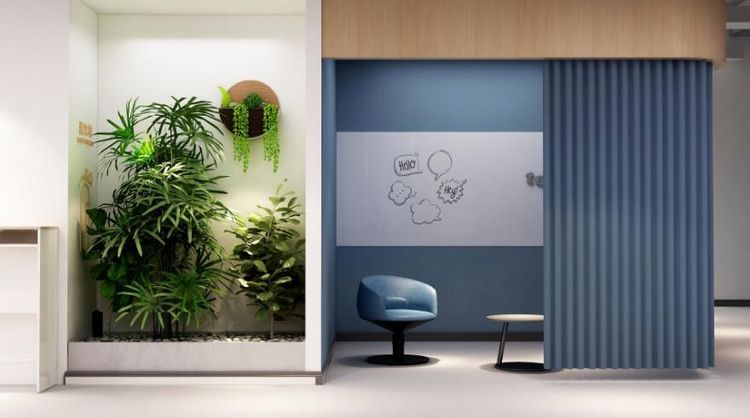
Discussing Post-Pandemic Design with J&A
There is no doubt that “getting out there” is a required course for designers — on one hand an exchange of inspiration, a collision of different standpoints and ways of thinking; on the other, an immersion in the changing times in search of a breakthrough.
In the third year of COVID-19 sweeping the globe, the way each of us works is being changed at a visible speed. Seeking the new within change is the task designers and brands must solve together.
From September 16 to 18, Yihang Technology joined hands with J&A (Jiang & Associates Design), ranked third worldwide in commercial design, for a design study tour.
Through a multi-dimensional experience of “viewing, learning, researching, and exploring,” the trip prompted deeper thinking about the interactions between people and space, design, and the environment in the post-pandemic era.

I. Post-pandemic design: seeking the new within change
In order of presentation
Zhang Lanxia — talk: “Viewing Post-Pandemic Office Environment Design Through the 'Allen Curve'”
“We apply the 'Allen Curve' to the design and planning of office spaces. We hope that post-pandemic offices can help employees close both physical and psychological distance, better fostering emotional bonds between employees and emotional resonance between employees and the company.”
Wang Danqiong — talk: “The Future of Work: A Survey of Chinese Enterprises' Workplaces | How to Build the Workplace of the Future”
“Chinese enterprises — and in fact companies everywhere — face a business environment that is constantly changing, unpredictable, and increasingly competitive. Their employees increasingly need to collaborate with others anytime, anywhere — often across different cities, countries, or even continents. To succeed in business under these conditions, companies must become agile, especially in their real estate footprint and office space.”
Chen Lihuan — talk: “Poetic Design”
“Those of us busy with commercial design — how do we create work that moves people? Live and work with love, and give your work a poetic realm.” “When I design, I give the building a personality, pour in my own feelings, and cherish the people who live there and their subjective impressions. — Takeyoshi Nakamura”
Lü Huimin — talk: “The Application and Research of Office Space Concept Design”
“Research on office space in China started later than abroad and largely follows leading foreign design thinking, so many workplaces look identical in style and layout. In the post-pandemic era, people's demand for workplace experience has grown — they want to break with tradition and expect place design to emphasize theme, identity, and human-centeredness.”
Li Mu — talk: “The Application and Empowerment of Soft-Furnishing Furniture in Different Style Spaces”
“The structure and form of furniture greatly influence the style and taste of interior design and can give a space a second life. We need to think about the organic integration of furniture and space within specific settings.”
Gao Chuqian — talk: “The Making of a Photo Retoucher”
“In different buildings, discover their exclusive personality symbols; in different scenes, think about how people behave in the space; and finally, use soft furnishings to refine the space.”
II. Diverse scenes, coexisting with nature
The American author Richard Louv proposed a theory — “nature-deficit disorder” — broadly describing the state of city dwellers long cut off from nature. From building garden factories to proposing the brand philosophy of “bringing nature into the office,” from the water-based finishing technology independently developed in 2015 to the “healthy work, formaldehyde-free offices” initiative put forward in 2022, we have always insisted on coexisting with “nature.”
For designers, measuring with one's own feet is far more compelling than any written description. So we led the J&A designers on a tour of the Qiandao Smart Manufacturing Base, the Yihang Sci-Tech Innovation Park, and the 80,000-square-meter office showroom.
Letting the designers experience the factory firsthand, examining and judging raw materials with a critical eye; walking the campus, feeling Yihang's philosophy dissolved into natural elements of fair-faced concrete, wood, water, light, and space; immersing themselves in the showroom to review our thinking on the work modes and environments of the past, present, and future.
As the tour and exchanges deepened, both products and philosophy ceased to be nouns floating on the page — this was a dialogue running in both directions.
III. Distilling creativity, seeking the classics
For designers, engaging the world with an open mind is itself a way of drawing in creativity. So at the end of the trip, we visited the Liangzhu Museum, designed by the renowned British architect David Chipperfield, together with the J&A designers. Entering the museum by bridge from the park, approaching from afar, one feels the building's sculptural mass emerge from the natural landscape, changing with distance.
During the visit, we came to understand and accept each other's new ideas on design, products, and space, jointly explored the issues arising in production and cooperation, and planned to put them into practice in our designs.
*** About J&A**
Shenzhen Jiang & Associates Creative Design Co., Ltd. (J&A) is one of the largest interior design firms in Asia. As the first Chinese interior design company listed on the A-share market (300668.SZ), J&A ranked 25th overall in Interior Design magazine's 2019 Global Design Giants ranking — 3rd in commercial design worldwide, and first in both Asia and China. Headquartered in Shenzhen, J&A has regional offices in Shanghai, Hong Kong, Beijing, Wuhan, Dalian, and Xi'an. It serves four major design fields: commercial complexes, healthcare complexes, transportation complexes, and culture & education complexes. Today it employs more than 800 international professionals across architecture, interior design, MEP, wayfinding, lighting, visual merchandising, and intelligent systems, with projects spanning shopping centers, office spaces, hotels, real estate, healthcare and eldercare, public buildings, rail transit, culture and education, and more.
You may also like
Healing Office Workers' Obsession with Symmetry in Design
Read More
Post-Pandemic Interior Design: Productivity in Truly Safe Places
Read More
European Designer Interview: Uncovering the Fun of Office Furniture
Read More