Deep Dive: Understanding Competition in China's Office Furniture Industry
China's modern office furniture industry has enjoyed nearly a decade of rapid growth and has now entered a period of slower development. Government procurement controls, a wave of real estate collapses, and raw-material inflation have hit one after another, compounding the woes of already-weak office furniture companies. Facing a sluggish stock market, they have no choice but to roll up their sleeves and fight hand-to-hand. Manufacturers that once focused on production must now ask themselves: Where is our market? What makes our products competitive? What do our users really care about? These brand-new questions are pushing the industry into its second half: digging deep into users and competing on brand — a challenge, and even more an opportunity! Below, we discuss the core logic of competition in the office furniture industry.
(Part One)
The state of the domestic office furniture industry:
"Ant-sized companies" everywhere reflect the industry's inefficient production-and-sales model
The defining feature of China's domestic office furniture market is the "ant" phenomenon. In Europe, the US, and Japan, the industry's CR3 (top-three concentration) can reach 80%.
What exactly makes China's office furniture industry so fragmented and small? The key is an extremely inefficient production-and-sales model, behind which lie several problems constraining companies' growth — and major hurdles the industry must keep breaking through.
Problem 1: Make-to-order production constrains growth
As a traditional labor-intensive manufacturing category, the vast majority of office furniture companies still rely on a make-to-order model. The factors of production are relatively stable and heavily dependent on manual labor: materials are prepared and produced per order, delivered on schedule. The biggest problems are inconsistent quality, low efficiency, and long delivery lead times — and larger, high-volume orders can be difficult to fulfill independently, severely limiting growth. Given the limits of make-to-order, leading companies such as Dio have begun shifting to "produce-to-sell": setting revenue targets based on capacity plans and matching market teams, using market data and digital systems to achieve modern industrial manufacturing — dramatically raising production efficiency, lowering costs, and driving rapid, large-scale growth!
Problem 2: Too many categories, crushing inventory costs
There is a curious phenomenon across the office furniture system: companies doing single products often outperform those doing systems — plenty of single chairs sell for hundreds of millions, while system office furniture is rare. Product copying runs rampant in the industry, and the sheer variety of scenarios, materials, styles, and functions creates a bloated catalog of system products. Lacking R&D on core products, companies follow and copy, generating a flood of SKUs — low order volumes per item, excess inventory, and persistently high costs. As Michael Porter argued, focus has become one of the key strategies for the office furniture industry: making products refined and hit products is a strategic choice the industry cannot avoid. Only then can companies achieve large-scale modern industrial manufacturing — the essential path to lower costs and higher efficiency.
Problem 3: Relationships win — the "local boss" phenomenon behind regional ties
The essence of office furniture sales is B2B: whether a major project or a small purchase, decisions are made by committees. Driven by bidding processes and designated partnerships, information channels and relationship resources are the key elements of industry sales. This makes office furniture companies intensely regional, with many "local boss" firms ranging from tens of millions to billions in revenue. For office furniture leaders to reach the absolute dominance seen in the consumer furniture sector, they must break through these regional barriers and achieve a dramatically larger market share and brand authority. Brand value is therefore the key element — the direction companies are exploring, and also their biggest "blind spot."
Problem 4: Information asymmetry — manufacturers lack market voice
Office furniture is an extremely low-attention, highly information-asymmetric market. Unlike consumer furniture, where strong brands shape buyer decisions, most office furniture purchasers have little idea which companies exist — and even through procurement directories and tenders, users deal with channel agents rather than manufacturers. Channel players thus control most customer resources, and with them the power over manufacturers and supply. Interest-driven channel players are also fertile ground for "ant factories." Companies must break through the information asymmetry; using brand awareness to drive buyer choice is a key strategic task for the future.
(Part Two)
The essence of competition in the domestic office furniture industry:
Behind the traditional mass-distribution model, the most primitive logic of product competition
Today's office furniture industry is still essentially in a traditional wholesale-and-distribution era: it prizes volume — who sells to whom — classic product competition. The three elements of product competition are quality, price, and appearance/style, and they have shaped an industry competitive landscape rooted in product characteristics.
The industry has long been said to have two schools: the Guangdong school and the Hangzhou school. The Guangdong school excels at high-volume, value-for-money products; the Hangzhou school is strong in product and space design. In competitive terms, by product tier the field splits into three camps: moving from high-end to mid-and-low-end, competition shifts from original design to product innovation to winning on value for money. The three camps' strategies can be summarized by the "father of strategy" Michael Porter's three generic strategies.
1. The mid-and-low-end camp: leading on volume
Behind winning on value for money: overall cost leadership
How do you differentiate low-barrier, homogeneous products? The essence of the mass mid-and-low-end market is differentiation on price. This camp consists mainly of Guangdong-school companies — represented by Dio, Huasheng, and Zhongtai — which use large-scale manufacturing for efficient batch production and tighter cost control, then balance production and sales through mass-distribution channels to lead on volume with value for money. Dio, the exemplar of value for money, runs on the slogan "High quality, honestly affordable." From a marketing perspective, the leading mid-and-low-end camp relies on three strategies.
Strategy 1: Omni-channel
China's office furniture runs on two core channels: retail terminals and projects. In the domestic market, companies enter every channel they can — brand showrooms and every kind of partner outlet. Dio, for instance, has more than 500 showrooms nationwide, with even more partner and service outlets. Meanwhile, the project channel accounts for more than half of total sales, and companies recruit project partners en masse by province and city. They have also fully entered traditional e-commerce and procurement platforms, covering enterprise customers nationwide through a diversified distribution network.
Strategy 2: Multi-brand
Multi-brand strategies achieve deeper market enclosure. The office furniture market has a hub-and-cluster character: distribution hubs offer clear shipping advantages, and companies and agents protect each other's interests. In a resource-hungry industry like office furniture, one agent often cannot cover a premium region, so companies use multi-brand strategies to attract more partners and radiate channel and customer resources more densely and deeply. Zhongtailong Group owns China Pai (Zhongtai, Guojing, Paige) as well as Heyan and other brand series; Dio Group alone fields an array of more than 10 brands.
Strategy 3: Hit products
A simple truth: making 100 units of a product and making 1 million units are costs of different orders of magnitude. The mid-and-low-end camp uses a hit-product strategy — distilling the product line, slashing SKUs, and achieving "fewer items, more volume" — meeting market demand with a cost advantage. Just as Oppein Custom's "19,800 package" won the market with massive cost control, Dio Group's Youpinbang "desk-chair-cabinet hit trio" at ultra-low prices achieves huge single-item volumes — planning production against future sales to lock in the cost advantage.
2. The mid-to-high-end camp: product innovation
Behind winning through innovation: differentiation strategy
Positioning in the mid-to-high-end means their customers are mainly well-funded private enterprises — especially Fortune Global 500 and China 500 top-tier companies. Because these customers concentrate procurement through tenders and similar processes, mid-to-high-end players focus on project-style and agent-based sales and on building regional customer experience centers. The most critical point: how do they become these customers' choice? By building brand value — grounded in user needs, creating differentiated products and services that raise the company's worth.
Technology innovation
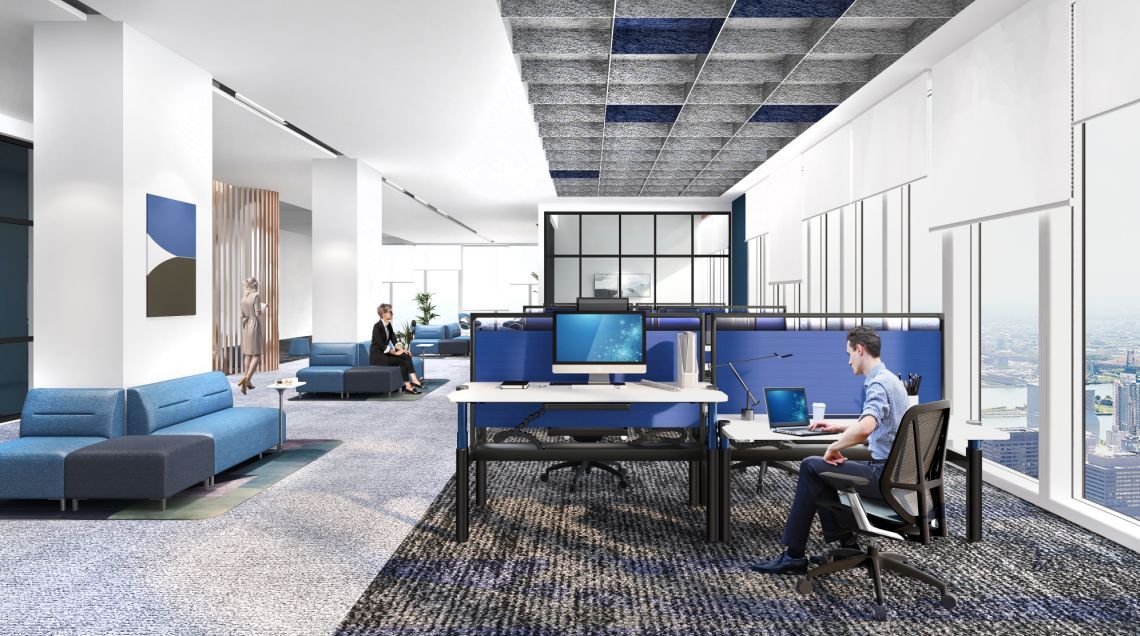
Under the advocacy of international office furniture concepts and pushed by the demands of big internet and tech clients, freedom, health, openness, and technology in work life have become new goals for office furniture. Ergonomics and workplace information technology are the mainstream directions of innovation, with highly automated adjustment, dynamic office spaces, touch-controlled equipment, and human health monitoring products emerging constantly. Among them, Yihang Group's ergonomic products and auto-adjusting desks and chairs have become high-profile market products, winning numerous awards with steadily rising sales.
Environmental upgrades
The industry's green track runs in two directions: one is panel-standard innovation, exemplified by "Zhaosheng's eco-friendly MDF powder coating"; the other is European and American environmental philosophy, exemplified by "Mercury's sustainable European environmental standards." Either way, eco-health has gradually become the mainstream for mid-to-high-end office furniture. Meanwhile, with national regulations now explicitly governing panel formaldehyde and indoor health standards, Fortune 500 customers have clear national procurement norms — the green track is no longer a concept, but an absolute strategy for mid-to-high-end office furniture companies.
Niche segments
Office furniture spans many niche segments — by use, style, and user, including hotels, healthcare, display, and offices — and furniture needs differ sharply from one segment to the next. Companies therefore focus their products on a niche to build a specialized positioning: Golden Phoenix specializes in hotel furniture, Yihang focuses on Fortune Global 500 enterprise clients, Changjiang concentrated early on government furniture... Leadership is achieved through expertise in a specific product field.
High-end customization
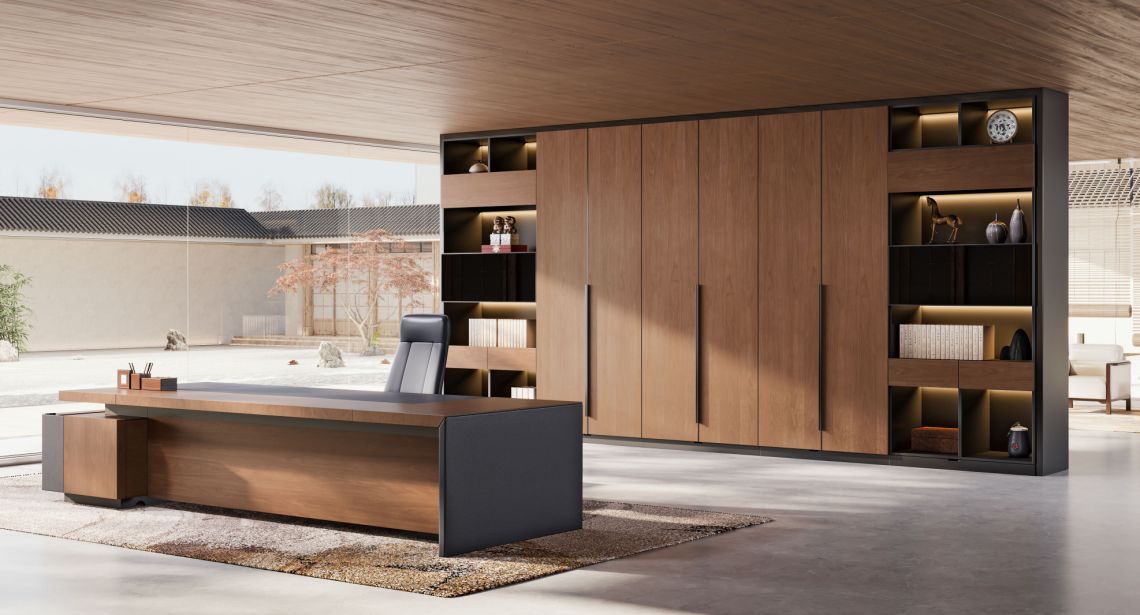
As leading companies grow larger and more discerning, office furniture will likewise enter an age of customization — concentrated in high-end customization for executives' private offices. High-end customization achieves balanced, coordinated whole-office sales; for finished furniture, desk-to-cabinet sales ratios are often lopsided, even poached by interior decorators. Company data show three desks must be sold for every one file cabinet. High-end customization digs deep into customers' product needs — and, in today's mature digital-systems era, it is both an important direction of product evolution and a path for office furniture companies' business transformation.
3. The high-end camp: design-driven
Focus on original design, lead customer demand
High-end office furniture buyers come mainly from the Fortune Global 500 — Coca-Cola, Starbucks, and the like — companies that care about team culture and the overall atmosphere of the office. Their strategy, therefore, is design: all resources go ALL in on product and space design — original product spaces, international design teams, superlative experience showrooms... MarsZu (Matsu) strategically partners with German furniture brand resources and has invested heavily in design masters from Germany, Italy, and beyond, highlighting its global design philosophy and strength; Maratti actively participates in major international design shows worldwide, showcasing the agile beauty of its design; Klocano built a super experience showroom at Shanghai's Qibao Longfor City, expressing its ongoing exploration of future design... All are presenting their formidable design capabilities in three dimensions and delivering system office space solutions that lead customer demand.
In the past, office furniture companies held on to many traditional factory mindsets; production orientation and the wholesale model will become things of the past. In the future, as the market changes and customer demands upgrade, China's office furniture industry will trend toward branding, consolidation, and a younger profile. In the second half — deep engagement with users, products, and brands — we expect a group of outstanding leading companies to rise to the challenge.
You may also like
European Designer Interview: Uncovering the Fun of Office Furniture
Read More
Inclusive Office Design: Optimizing Furniture for Happiness
Read More