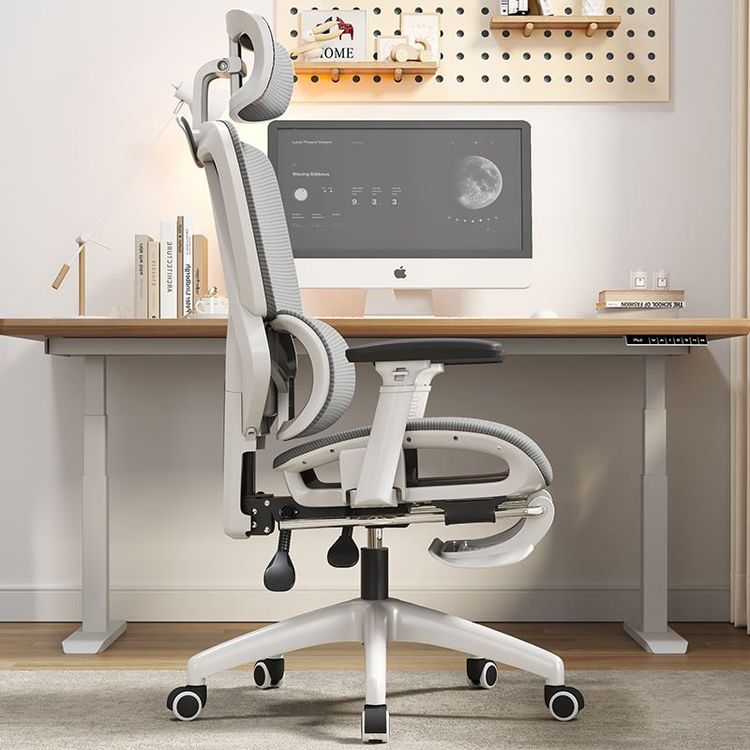
How to Choose the Right Mesh Office Chair
Choosing the right mesh office chair requires considering six core factors: posture support, cushion quality, backrest design, adjustability, breathability, and safety and durability.

1. Posture Support The primary function of a mesh office chair is to maintain proper sitting posture, with a focus on adjustable design. The ideal seat height should be between 450-550mm, ensuring feet are flat on the ground and knees are bent at a 90° angle; a seat depth of 400-440mm is recommended to avoid compressing blood vessels behind the thighs; the backrest height should cover the lower edge of the shoulder blades, providing continuous support from the waist to the neck. Some high-end models (such as the Marsail series) feature adjustable tilt angles to accommodate different work postures.
2. Cushion Quality A high-quality cushion should have moderate elasticity and a balanced softness and firmness. Too soft can cause the buttocks to sink, while too hard increases pressure on the tailbone. It is recommended to choose a cushion with a concave curve to distribute pressure evenly. High-end models often use “memory foam” technology, which automatically adjusts support density based on sitting posture and body shape, reducing the risk of lumbar fatigue over long-term use.
3. Backrest Design Mesh backrests offer better breathability than traditional materials, but structural strength must be considered. High-quality mesh should balance elasticity and toughness, conforming to the spinal curve while avoiding sagging or deformation over time. Focus on checking support designs in the neck, waist, and shoulder blade areas, such as the adjustable lumbar support and headrest combination in Marsail chairs, which effectively distribute upper body pressure.
4. Adjustability Personalized fit is a key indicator. In addition to basic height adjustment, the headrest should support vertical and angular adjustments to match the cervical curve of users of different heights; armrests should have lift, forward/backward, and rotation functions to prevent arm suspension; lumbar supports are recommended to be removable or pneumatically adjustable to accommodate the lumbar curves of users with different body types.
5. Breathability The advantage of mesh structures lies in air circulation, but attention should be paid to weave density. High-quality mesh should use high-strength polyester fibers with a porosity of 30%-50%, ensuring ventilation while preventing direct skin contact with metal frames. Some models enhance support with double-layer mesh designs while maintaining breathability.
6. Safety and Durability Material selection directly affects service life. The frame is recommended to use thickened steel tubes (wall thickness ≥2mm) with a load-bearing capacity of over 150kg; the gas lift must be BIFMA-certified to ensure smooth lifting and no explosion risk; the five-star base material should preferably be nylon reinforced with glass fibers, which offers better impact resistance than ordinary plastics. When purchasing, you can request to view the product's SGS or TUV test reports.