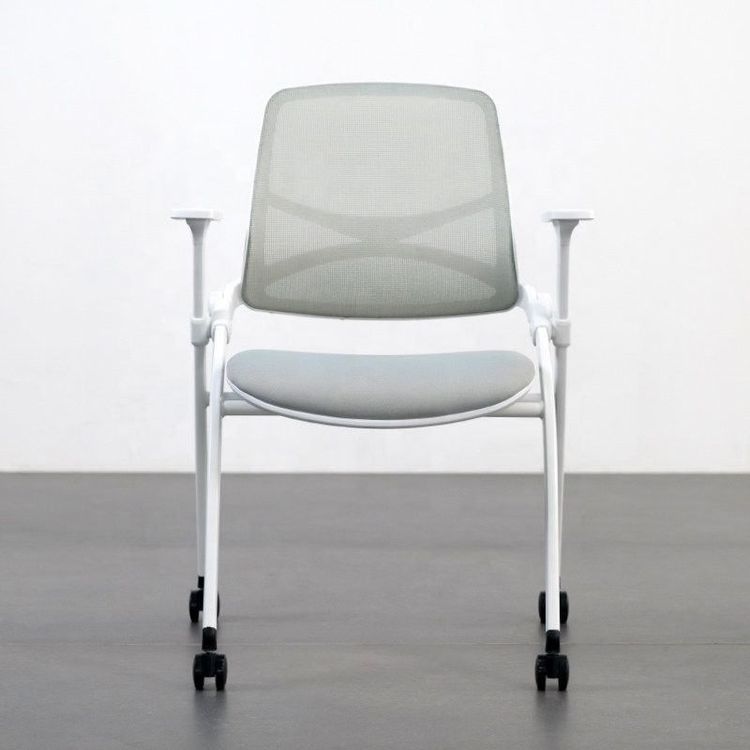
Slow-Rebound Office Chair
The slow-rebound office chair is an office seating solution centered around slow-rebound materials, offering pressure dispersion, temperature adaptability, and stable support. Its core principles and advantages can be analyzed from the following perspectives:

1. Pressure Dispersion Mechanism: Delayed Rebound and Contact Area Optimization
The molecular structure of slow-rebound materials endows them with “viscoelastic” properties. When compressed, they do not rebound immediately but gradually recover over a period of several seconds. This characteristic aligns closely with the pressure distribution process when a person sits down: ordinary foam cushions rebound quickly under pressure, causing the reactive force on the buttocks to be nearly synchronous with the applied downward force, which can easily create instantaneous pressure peaks in the ischial tuberosity area. In contrast, slow-rebound materials delay the rebound, shifting part of the pressure backward along the time axis and reducing the impact of peak pressure on local tissues. From the perspective of contact mechanics, when sitting, body weight is primarily transmitted to the seat surface through the ischial tuberosities, the back of the thighs, and the soft tissues of the buttocks. A hard seat surface concentrates pressure on two small contact points, forming a sharp “bimodal pressure curve.” Slow-rebound materials deform under pressure, gradually expanding the contact area as the degree of deformation increases. This reduces the pressure per unit area, flattening the pressure distribution curve and creating a “platform-like support,” thereby lowering the risk of local blood circulation obstruction caused by prolonged sitting.
2. Temperature Adaptability: Dynamic Support and Shape Retention
Slow-rebound materials are temperature-sensitive. Upon human contact, the temperature in the contact area rises, causing the material's modulus (stiffness) to decrease and its degree of deformation to increase further. This process is gradual and does not result in immediate softening due to sudden compression. Instead, it adjusts the support force step by step based on the combined effects of pressure and temperature. In prolonged sitting scenarios, this characteristic manifests as follows: the cushion maintains relatively stable support in the first few minutes and then gradually adapts to the individual's buttock contours, forming a “personalized fit.” However, it should be clarified that this adaptation is not professional shaping but rather the material's slower recovery to its original shape after pressure is released, preserving the initial form for the next use. Therefore, when the same cushion is used alternately by different individuals, the starting state of pressure distribution for the next use is not significantly affected by the previous deformation, balancing support stability with universal usability.
3. Material Selection and Product Form: Balancing Deformation and Support
In office chair design, slow-rebound materials are commonly used in two forms: first, as the cushion material for ergonomic chairs, such as high-density foam or dedicated slow-rebound layers, which achieve buttock support and pressure dispersion through a multi-layer structure; second, as standalone cushion products, typically with a thickness controlled between 4-6 centimeters to strike a balance between deformability and support. Medium-density slow-rebound materials are ideal, as they provide progressive support after deformation, avoiding issues such as bottoming out (where the cushion is compressed to the hard base, losing its cushioning effect) due to excessively low density or overly rapid rebound that weakens pressure dispersion due to excessively high density.
In summary, the slow-rebound office chair achieves comprehensive optimization from instantaneous pressure management to long-term support stability through the combination of material properties and ergonomics, making it particularly suitable for office scenarios requiring prolonged sitting.