Back to blog
Article
Office Chair Recline Adjustment
Admin October 09, 2026
Office chair recline adjustment is usually achieved through buttons or specific structures, with the specific method varying depending on the design. Common operations are as follows:

I. Basic Button Adjustment Mechanism
Most office chairs adopt a button-based locking/unlocking design, with the core logic being "push to lock, pull to unlock":
- Locked State: Push the button inward to the locked position. At this point, the backrest and the base form a fixed structure, allowing only height adjustment (via the gas lift for up and down movement) and preventing reclining or lying flat. This design prevents accidental movement of the backrest due to accidental touches, ensuring safety during use.
- Unlocked State: Pull the button outward to the released position. The connection between the backrest and the base becomes loose, allowing the user to apply pressure by leaning back to adjust the seat to the desired recline angle (usually ranging from 95° to 160°). After adjustment, the button needs to be pushed inward again to lock the angle and prevent sliding during use.
II. Advanced Stepless Adjustment and Footrest Function
Some high-end office chairs incorporate stepless adjustment and footrest linkage designs in addition to basic adjustments:
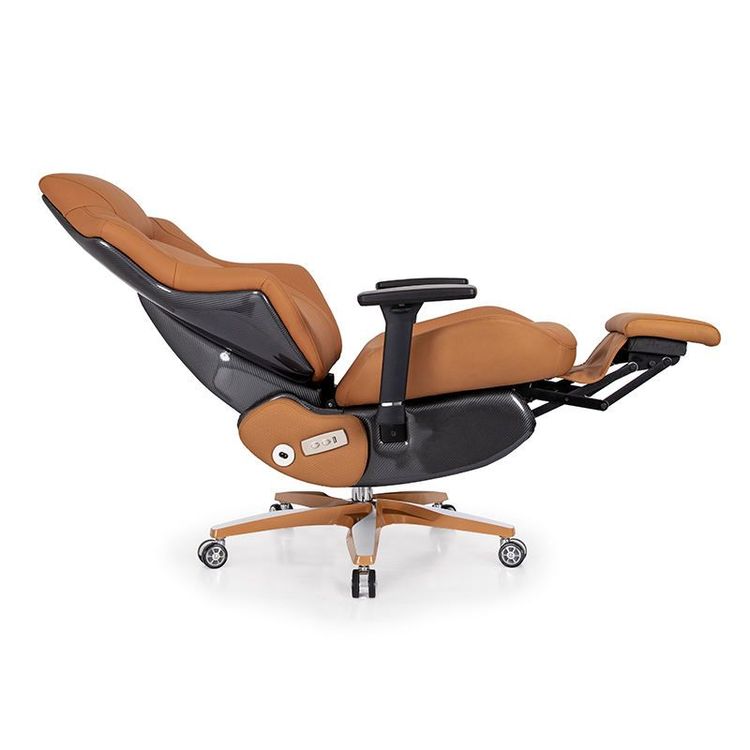
- Stepless Adjustment: The backrest supports continuous angle adjustment from 95° to 160° (non-fixed positions), allowing users to precisely control the recline amplitude according to their needs, adapting to different scenarios such as office work, reading, and napping. During adjustment, keep the button in the unlocked state and lean back slowly to the target angle before locking it.
- Footrest Linkage: When the backrest is adjusted to a nearly 160° lying-flat position, a hidden footrest (usually located under the front of the seat) can be pulled out to form a nearly horizontal lying position. The footrest can often be pulled out manually or triggered by a button. For some models, the footrest needs to be operated after unlocking the backrest to avoid structural conflicts.
III. Operation Precautions
- Force Control: Avoid applying excessive force during adjustment, especially sudden leaning back in the unlocked state, which may cause the backrest to recline rapidly and lead to imbalance.
- Weight Adaptation: The recline resistance of some office chairs is related to the user's weight. Lighter users may need to apply more force when leaning back or use the tension adjustment knob (if available) under the backrest to reduce resistance.
- Regular Inspection: After long-term use, the button or locking mechanism may become loose due to wear and tear. Regular inspection and contacting after-sales service for maintenance are necessary to ensure the normal functioning of the adjustment features.
Related