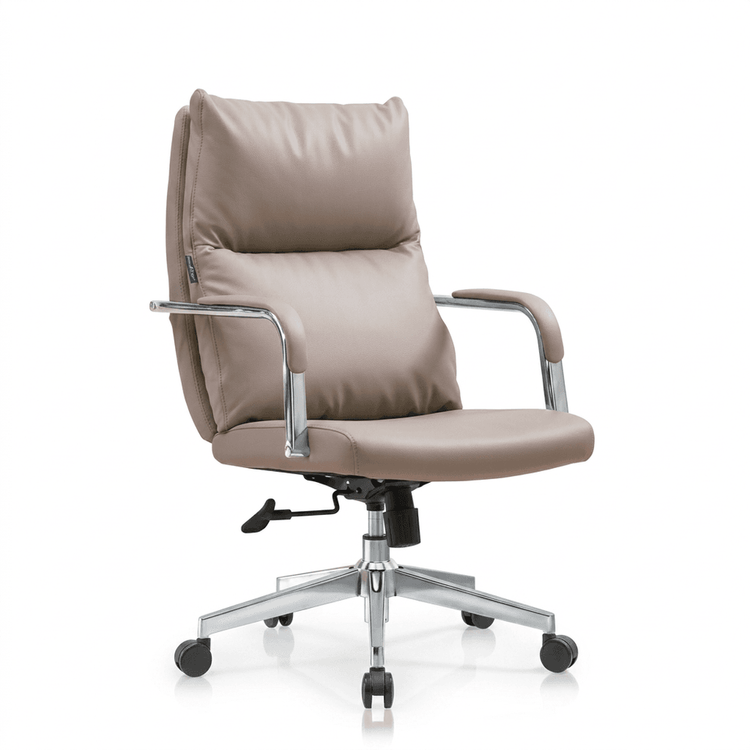
Office Chair Perspective
Office chair design should balance ergonomic parameters with real-world usability to achieve a harmonious blend of functionality and comfort. Key design considerations are as follows:

I. Core Ergonomic Parameters
- Seat Height: Proper seat height is fundamental for comfortable sitting. It can be calculated as 'lower leg length + foot height + shoe thickness - appropriate space', with an optimal range of 43-53 cm. Excessive seat height can cause feet to dangle and thigh compression, while insufficient height can lead to excessive knee flexion and increased lumbar strain.
- Seat Depth: Seat depth, the distance from the front to the back edge of the seat, should be moderately set at 38-46 cm. Excessive depth can compress blood vessels and nerves in the back of the thigh, causing numbness, while insufficient depth fails to adequately support the back, leading to lower back pain.
- Seat Design: The seat width should accommodate the user's hip size with room for movement, typically not less than 38 cm; the seat angle should be slightly reclined (about 5°) to distribute hip pressure and promote a natural sitting posture.
- Armrest Height: Armrest height should be coordinated with the seat, typically controlled within 19-25 cm. Appropriate armrests provide stable support when standing up or changing positions, preventing shoulder and neck fatigue caused by arm suspension.
- Lumbar Support Design: Lumbar support height should be located between the fourth and fifth lumbar vertebrae (15-18 cm from the seat cushion) to fit the natural curvature of the spine, distribute lumbar pressure, and relieve muscle tension.
II. Optimization of Real-World Usability
- Dynamic Support: High-quality office chairs should adapt to different work scenarios. For example, the Shuangmuma office chair features a backrest curve that fits the physiological curvature of the spine, providing a resilient support surface that distributes upper body pressure; the seat cushion's depth and curvature design can stably support the hips and thighs, avoiding pressure.
- Adjustability: Free height adjustment is crucial. Smooth lifting and lowering via a gas lift help users find the optimal sitting position where 'feet are flat on the ground and thighs are parallel to the ground', reducing fatigue from prolonged sitting.
- Material Selection: The seat and backrest should use breathable, moderately elastic materials (such as high-density foam + breathable mesh) to balance support and comfort, avoiding stuffiness or deformation.
III. Unity of Function and Form Design should innovate aesthetically while meeting ergonomic parameters, avoiding a sole focus on appearance at the expense of practicality. For example, a streamlined backrest can enhance visual appeal but must ensure its curvature matches the spinal curve; hidden adjustment buttons can simplify operation but must ensure clear functional labeling.
In summary, office chair design should be based on scientific parameters, incorporating dynamic support and adjustability to ultimately achieve the goal of 'healthy, efficient, and comfortable' use.