Office Chair Footrest
Office chair footrests come in a variety of types, with a wide price range, and their functional designs focus on ergonomics. Based on their usage and design characteristics, they can be mainly divided into two categories: integrated footrests for complete chairs and standalone footrest accessories, with prices ranging from a few yuan to over two hundred yuan. Their core functions are to alleviate fatigue from prolonged sitting and improve sitting posture.

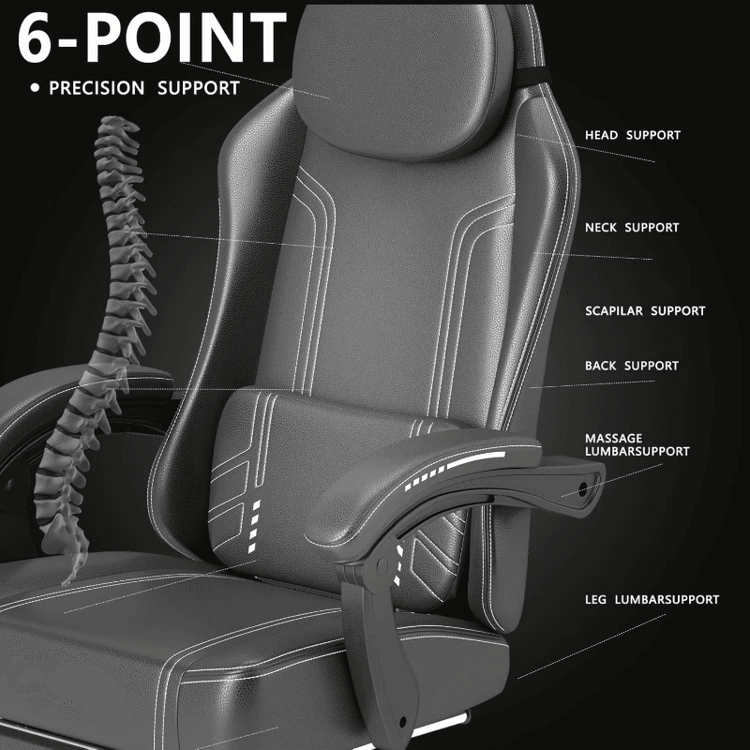
Integrated footrests for complete chairs are usually designed in conjunction with ergonomic chairs, offering higher prices but comprehensive functionality. For example, cross-border wholesale ergonomic office chairs with adjustable height, rotation, footrests, and nap functions (¥265.0) and ergonomic computer chairs for comfortable long-term sitting, suitable for office naps with a two-in-one design including a footrest and reclining function (¥266.95). These footrests form an integrated structure with the chair's main body, supporting height adjustment, rotation, or reclining functions, making them suitable for scenarios requiring long hours of work or napping. Their design is based on ergonomic principles, reducing leg pressure by elevating the legs while raising the lower body's center of gravity, allowing the back to naturally straighten and avoiding poor blood circulation caused by thigh pressure in traditional sitting postures. These footrests are often made of high-density foam or breathable mesh fabric, paired with reinforced steel frames to ensure load-bearing stability and durability, suitable for heavier users or high-frequency usage scenarios.
Standalone footrest accessories offer advantages in flexibility and cost-effectiveness, with lower prices but simpler functionality. For example, computer chair footrests for home office naps as office chair accessories (¥23.00) and cross-shaped footrest rings as accessories for office and bar chairs (¥16.00). These footrests are independent modules that can be adapted to most standard office chairs, typically installed using clips or screws. Their design focuses on providing basic leg support, with materials often being plastic or simple metal frames, covered with non-slip pads or soft edges to prevent sliding or scratching the floor. Although these footrests do not offer height adjustment or rotation functions, their fixed height design can still effectively alleviate leg swelling caused by prolonged sitting, suitable for users with limited budgets or low functional requirements.
In terms of functional characteristics, all types revolve around 'reducing the burden of prolonged sitting'. Whether integrated or standalone, their core goal is to adjust leg posture and distribute body pressure. For example, the integrated footrests of ergonomic chairs can adjust synchronously with the chair's angle, ensuring that the legs and body form a natural curve when lying flat, avoiding muscle stiffness; while standalone footrests, through their fixed height design, force users to maintain a correct sitting posture with 'feet flat on the ground', indirectly improving the distribution of back pressure. Additionally, some high-end models are equipped with detachable footrests or folding designs, balancing space utilization and practicality.