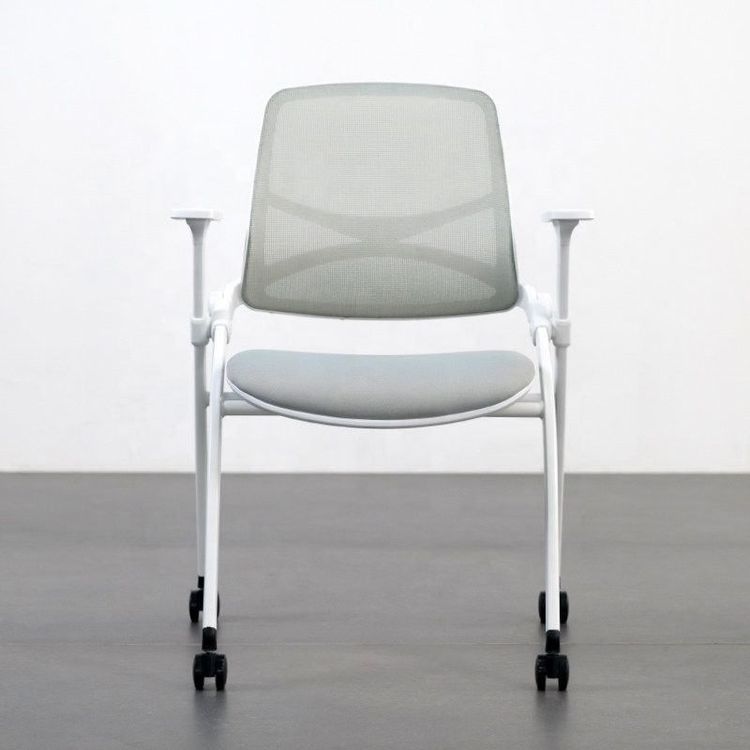
Office Chair and Customer Service Chair
There is currently no strict functional distinction between office chairs and customer service chairs. Customer service chairs are generally considered specific applications of office chairs in customer service scenarios. Both primarily serve to meet the needs of seated work, but customer service chairs may place greater emphasis on long-term sitting comfort and scenario adaptability.

Definition and Classification of Office Chairs
Office chairs are designed specifically for daily work and social activities, with their core function being to support seated desk work. In a narrow sense, they refer to backrest chairs used for desk operations (such as writing or computer use) while seated, requiring basic lumbar support and height adjustment functions to accommodate different heights and usage scenarios. Broadly speaking, office chairs encompass all types of chairs used in offices, including executive chairs (used by management, emphasizing authority and comfort), staff chairs (used by ordinary employees, focusing on cost-effectiveness and basic functions), and conference chairs (used temporarily, lightweight and easy to move). Their design must adhere to ergonomic principles, such as adjustable seat depth, backrest angle, and armrest height, to reduce fatigue from prolonged sitting and enhance work efficiency.
Scenario Adaptability of Customer Service Chairs
Currently, there is no explicit exclusive definition of "customer service chairs" in public information, but their characteristics can be inferred based on the work characteristics of customer service scenarios. Customer service work typically involves prolonged phone calls, handling customer inquiries, or operating computers, so customer service chairs may emphasize the following functions: 1. Long-term sitting comfort: Customer service personnel may spend more than 6-8 hours seated daily, so chairs need to have softer seat cushions, breathable fabrics (such as mesh), and adjustable lumbar support to reduce pressure on the buttocks and waist. 2. Scenario adaptability: Customer service desks and chairs often appear in combination (such as partitioned cubicles), so chairs need to match the height of the desk and the position of the screen to avoid neck or shoulder fatigue caused by height differences. For example, some customer service chairs may be equipped with adjustable gas lifts to accommodate different heights of customer service desks. 3. Lightweight and flexibility: Customer service scenarios may involve frequent movement (such as turning around to answer calls or communicating with colleagues), so chairs need to have a lightweight design or a wheeled base for quick position adjustments.
Relationship Between Office Chairs and Customer Service Chairs
From a functional perspective, customer service chairs are a细分 (subcategory) application of office chairs in customer service scenarios, with no essential difference between the two. For example, if a staff chair meets the comfort requirements of customer service work, it can be used as a customer service chair; conversely, the design concept of customer service chairs (such as long-term support) can also be applied to other office scenarios. Currently, "customer service desk and chair" products on the market (such as partitioned combinations and cubicle desks and chairs mentioned in the reference information) emphasize the overall adaptability of desks and chairs rather than the unique functions of the chairs themselves, further confirming the connection between customer service chairs and office chairs.