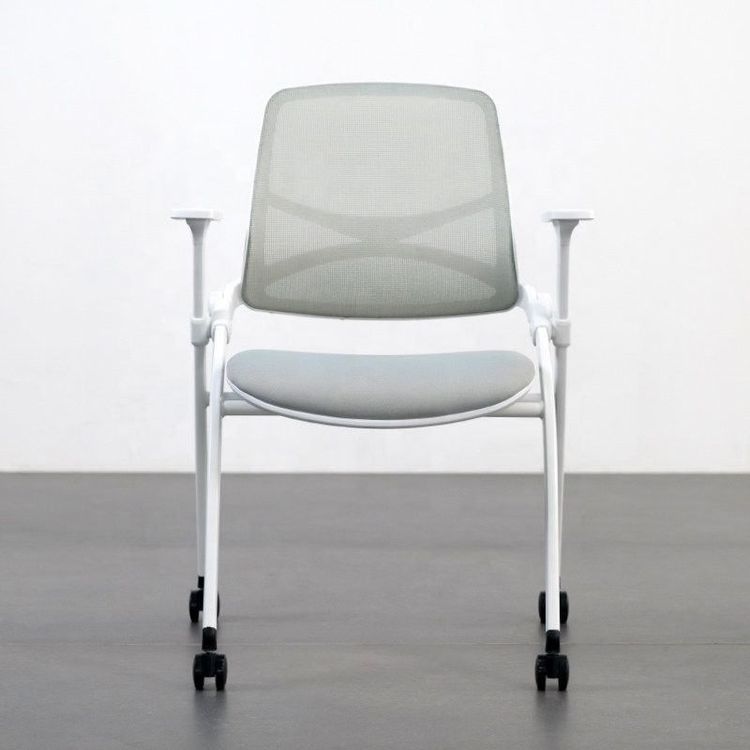
Office Chair Anti-Slip
Several methods can be employed to prevent office chairs from slipping:

Using paper trays or wheel stabilizers: This is a cost-effective and easy-to-implement method. Place paper trays, which you might accumulate from drinking coffee, beneath the wheels of your office chair. The friction between the paper trays and the floor effectively prevents the chair from sliding, without incurring any additional costs. If paper trays are not durable enough, consider purchasing wheel stabilizers and fitting them over the wheels. Wheel stabilizers are typically made of wear-resistant materials, making them more durable than paper trays and easier to move when adjusting the chair's position.
Adopting a chair with fixed feet: This design involves installing fixed feet at the bottom of the chair, creating a stable contact with the floor and providing excellent stability. However, this design sacrifices the chair's mobility; once fixed feet are installed, the chair becomes difficult to move freely. Therefore, it is more suitable for environments where stability is highly required, such as laboratories and workshops.
Using wheels with brakes: Wheels with brakes can be easily locked or unlocked to control the chair's movement. To fix the chair in place, simply press the brake mechanism on each wheel, and the chair will be firmly secured to the floor. To move the chair, unlock the brake mechanism. However, since office chairs typically have five wheels, locking and unlocking each wheel individually can be relatively cumbersome.
Adopting a gravity self-locking wheel design: Gravity self-locking wheels are a very convenient design. When a person sits on the chair, the wheels automatically lock, preventing the chair from sliding; when the person stands up, the wheels automatically unlock, allowing free movement. Some gravity self-locking wheels are also equipped with on/off switches, enabling users to switch between fixed and normal modes as needed, providing greater flexibility in use.
Placing a rough carpet beneath the chair: Increasing the friction between the carpet and the chair's wheels can reduce the chair's sliding. This method is suitable for occasions where stability requirements are not high, such as home offices.
Using fixed foot pads: Insert the fixed foot pads into the wheels after pulling them out to restrict the wheels' rotation, thereby preventing the chair from moving. This method is suitable for older users, such as elderly people or children at home, effectively avoiding accidental falls caused by chair sliding.
Switching to wheels with locking functions: For example, wheels with brake locking functions can be locked by pushing them down and unlocked by lifting them up for movement; there are also bearing-hollowed wheels that can be locked by pressing a button.