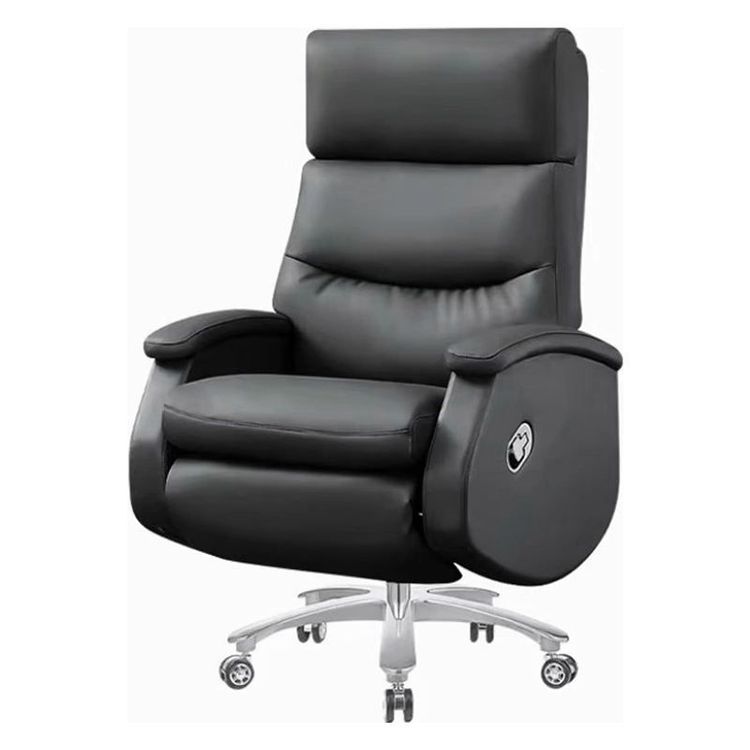
Principle of Office Chair Airbag
The principle of office chair airbags is mainly based on air pressure and elasticity, achieving functions such as auxiliary support, improved comfort, and enhanced stability by adjusting the air pressure inside the airbags.

1. Airbag Structure and Material Characteristics
Airbags in office chairs are typically made of highly elastic materials (such as TPU or rubber composite materials) and feature a hollow, inflatable internal structure. These materials combine flexibility with durability, enabling them to maintain a stable shape after inflation while adapting to the distribution of body pressure through deformation. The shape and size of the airbags are designed according to their functions; for example, lumbar support airbags are often curved to fit the contour of the lower back, while shoulder airbags adopt a multi-layered design to expand the support area.
2. Air Pressure Regulation Mechanism
The airbags are equipped with an internal adjustment system that enables inflation and deflation through side air valves (push-button or rotary types). Users can adjust the air pressure inside the airbags according to their needs, thereby changing the support intensity:
- Inflation Process: Increasing the amount of air causes the airbag to expand, increasing pressure on the limbs and enhancing support;
- Deflation Process: Reducing the amount of air causes the airbag to contract, decreasing pressure and accommodating different body types or sitting postures.
For example, when used as a lumbar support, an inflated airbag can closely conform to the concave area of the lower back, providing targeted support; when used as a seat cushion, adjusting the pressure can disperse pressure on the buttocks, alleviating fatigue from prolonged sitting.
3. Auxiliary Support and Comfort Optimization
By inflating and expanding, airbags apply uniform pressure to the limbs, achieving a “squeezing-kneading” effect that compensates for the limitations of mechanical structures:
- Local Support: Multi-layered shoulder airbag designs can fix the position of the shoulders, preventing slippage while relieving tension in the shoulder and neck muscles through uniform pressure;
- Dynamic Adaptation: The deformability of airbags allows them to automatically adjust pressure distribution in response to body movement. For example, when a user leans back, the lumbar support airbag can simultaneously expand to fill the gap in the back, maintaining continuous support.
4. Enhanced Stability Function
Some high-end office chairs enhance overall stability through airbag systems:
- Lateral Support: When the chair is subjected to lateral forces (such as when a user turns), the system automatically increases or decreases the air pressure in the corresponding airbags to create a counteracting support force, reducing wobbling;
- Center of Gravity Balancing: By independently adjusting the air pressure in the left and right airbags, the system can correct instability caused by off-center sitting postures, especially in the steering scenarios of wheeled office chairs.
Summary: Through elastic materials, air pressure regulation, and dynamic deformation mechanisms, office chair airbags achieve multi-dimensional optimization from local support to overall stability, making them a key technology for enhancing seat comfort and functionality.