Ergonomic Office Chair
Ergonomic office chairs are healthy seating solutions designed specifically for individuals who work long hours at desks or use computers, reducing the stress of prolonged sitting through adjustable structures and scientific support while enhancing comfort and health protection.

Core Design Principles and Functions
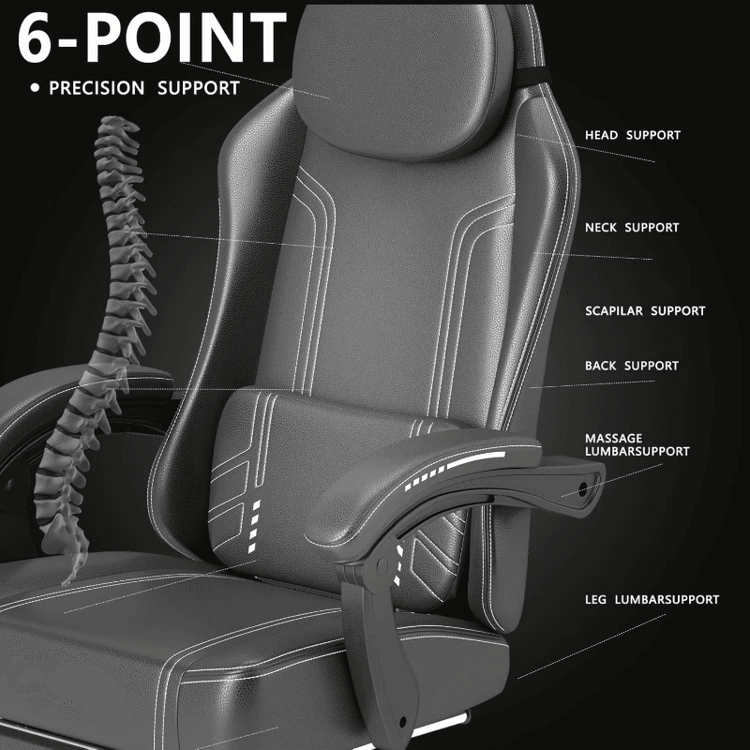
Ergonomic office chairs are based on ergonomic principles, optimizing support structures for prolonged sitting scenarios. Their core designs include adjustable headrests, backrests, lumbar supports, and armrests, dynamically fitting key areas such as the cervical and lumbar spine to distribute body pressure. For example, the 5D lumbar support of the Baibaidiao P2 Ultra can be adjusted vertically by 70mm and tilted forward and backward by 6.5 degrees, accommodating individuals with heights ranging from 150-190cm; the lumbar support of the Moga T1 slides along a curved track during recline, ensuring continuous support for the lower back with a maximum recline angle of 155 degrees. Additionally, the backrest curve aligns with the S-shape of the spine, reducing intervertebral disc pressure; the seat depth is adjustable, providing space behind the knees to prevent impaired leg circulation.
Material and Structural Adaptability
Material selection balances breathability and durability. Seat surfaces often use mesh or eco-friendly materials, such as the wrap-around mesh of the Baibaidiao P2 Ultra, which offers strong enclosure and breathability; the 4D headrest of the Moga T1 supports 7cm of forward and backward adjustment and is covered with cowhide material for improved tactile feel. The frame commonly uses nylon or aluminum alloy to ensure structural stability. Dimensional parameters reference human sitting posture data, with designs for seat height, width, and depth providing ample activity space to avoid localized pressure.
Health Standards and Market Development
Industry regulations drive product upgrades. In 2020, China released the national standard Ergonomic Requirements for Healthy Homes—Part 3: Office Desks and Chairs (GB/T 39223.3-2020), specifying material safety, structural adaptability, and health protection indicators; in 2023, the group standard Ergonomic Office Chairs (T/ZFA 18-2023), led by Hangzhou Baibaidiao, added requirements for lumbar support dimensions, safety, and mechanical performance testing, strengthening occupational health protection. In the market, global sales reached $14.38 billion in 2023 and are expected to grow to $20.28 billion by 2030, reflecting sustained demand growth.
Applicable Scenarios and User Groups
Ergonomic office chairs are widely used in homes, offices, internet cafes, hotels, and conference rooms, particularly suitable for programmers, designers, students, and others who need to maintain a seated posture for extended periods. Their adjustability accommodates different body types, such as the Moga T1's 12-degree stepless adjustment function for forward-leaning postures, meeting diverse work needs.