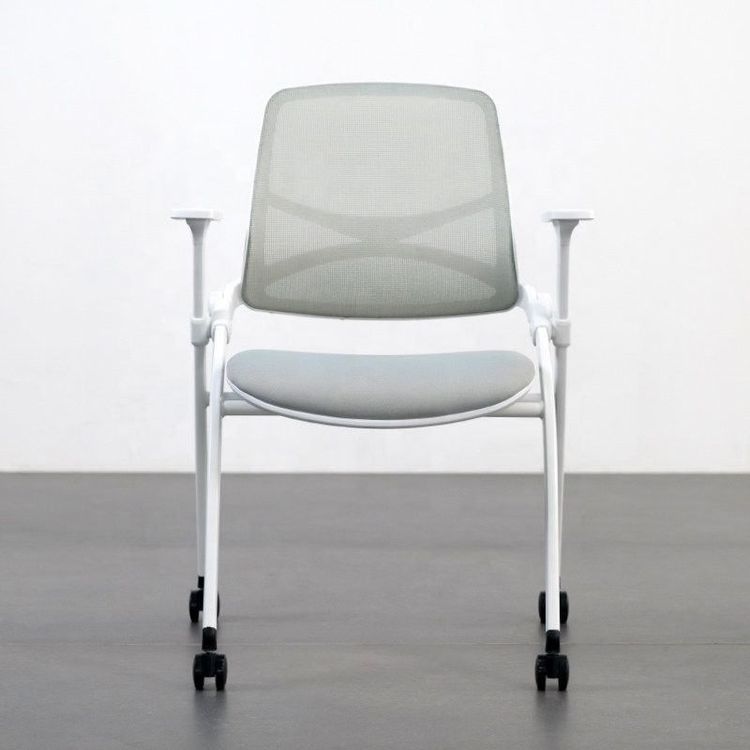
Design Description of Roller Skating Office Chairs
The design of roller skating office chairs revolves around structure, functionality, durability, and usage scenarios, balancing flexibility and ergonomic needs.

1. Structural Design and Core Functions
Roller skating office chairs are built around a core structure consisting of a base, gas lift, seat cushion, backrest, and wheels. The gas lift adjusts the height by compressing gas, accommodating different desk heights (typically covering a range of 120-150 cm). The seat cushion uses high-density foam to distribute pressure on the buttocks through its rebound properties, enhancing comfort during prolonged sitting. The backrest is often designed as a high backrest, paired with breathable mesh or waterproof fabric to support the lumbar spine while keeping the back dry. The wheels are generally universal casters, enabling smooth movement on both carpeted and hard floors, reducing the need to get up and move frequently.
2. Adjustable Functions and Scenario Adaptation
Multi-dimensional adjustability is a key advantage: height adjustment caters to users of different heights; the backrest angle supports reclining from 90° to 135°, meeting the needs of focused work and short breaks; the headrest provides additional support for the cervical spine, particularly suitable for those working at desks for extended periods. In open workstations, private offices, or meeting scenarios, the chair's mobility reduces spatial constraints and enhances collaboration efficiency.
3. Technical Specifications and Durability Assurance
Key specifications directly impact safety and lifespan: the weight capacity is approximately 150 kg, covering most adult weights; the gas lift must pass safety certifications such as SGS to avoid explosion risks; waterproof fabric prevents liquid penetration, extending the chair's lifespan; wheel materials should be selected based on the floor type (PU wheels for hard floors, nylon wheels for carpets) to avoid poor sliding or floor damage.
4. Special Safety Designs
Some models incorporate innovative designs to enhance stability:
- Combination of Caster Feet and Adjustable Fixed Feet: The fixed feet can be raised or lowered via a gas lift or mechanical structure, switching between stable and flexible modes;
- Gravity Self-Locking Casters: These casters integrate a mechanical brake inside the wheel, automatically locking the wheels when the user sits down and releasing them when they stand up, balancing mobility convenience and safety.
5. Quiet Design for an Optimized Office Environment
To meet low-noise demands, quiet wheels reduce noise through material and structural improvements: using viscoelastic materials like polyurethane or thermoplastic elastomers instead of hard plastics, or wrapping a soft outer ring around a hard wheel hub, alters the vibration energy transfer path, significantly reducing rolling noise and enhancing office concentration.