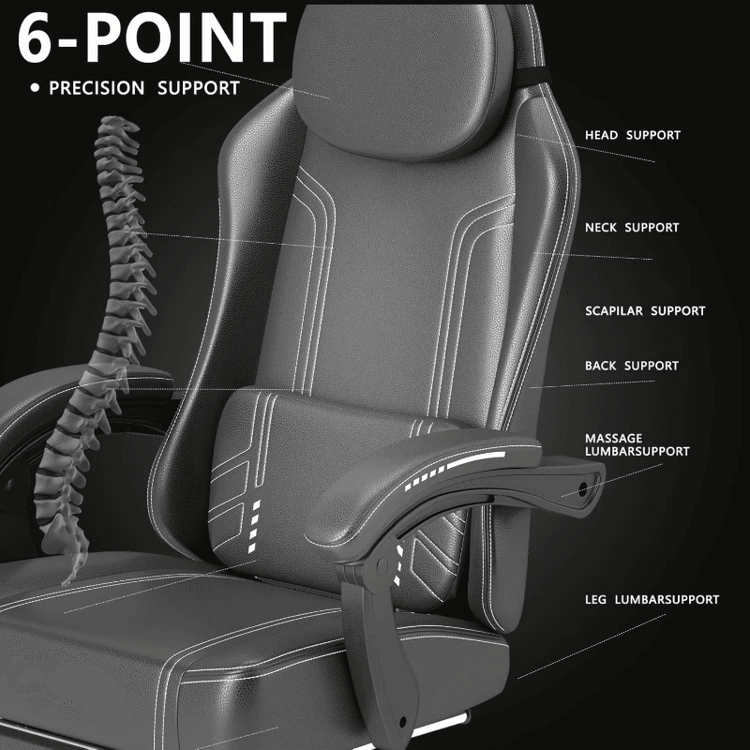
Bow-shaped Office Chair Reclining
The safety of a bow-shaped office chair when reclining depends on whether it is equipped with a limiting device and how it is used. A reasonably designed product can ensure safety, but improper use or low-quality products pose risks.

1. Limiting Device as the Core of Safety
When a bow-shaped chair with a limiting device is reclined, the backrest automatically locks at a preset safe angle (e.g., some products are set between 100° and 135°), preventing excessive reclining that could lead to tipping forward. This design locks the backrest position through a mechanical structure, ensuring the user's center of gravity remains stable, making it particularly suitable for office scenarios where short breaks are needed. If the chair lacks this device and the backrest is fixed with a hard material, forced reclining may cause tipping forward due to a shift in the center of gravity, with off-brand products posing a higher risk due to insufficient structural strength.
2. Design Optimization for Pressure Distribution through Structure
Some bow-shaped chairs enhance safety and comfort through dynamic structures. For example, the Gong brand bow-shaped chair allows the backrest to recline by about 30 degrees while the seat moves forward by about 10 centimeters simultaneously, creating a "linked support" effect. This design increases the contact area between the buttocks and the backrest during reclining, distributing pressure more evenly while maintaining body balance. However, it should be noted that the reclining angle of such chairs is usually relatively small (generally not exceeding 35 degrees), and they need to be used with elastic materials (such as high-density foam) to avoid local compression caused by hard materials.
3. Potential Hazards of Incorrect Sitting Postures
Even if the chair is designed safely, long-term "slouching" (i.e., half-lying with the waist suspended) can significantly increase lumbar spine pressure. In a normal sitting posture, the lumbar spine bears about 140% of body weight; when slouching, with a lack of support for the waist, the pressure can rise to 185% of body weight, easily leading to lumbar muscle strain or intervertebral disc herniation. It is recommended to maintain a posture where the back is pressed against the backrest and the feet are flat on the ground. If necessary, use a lumbar support to fill the gap at the waist to distribute pressure.
4. Purchase and Usage Recommendations
- Prioritize products with limiting devices and confirm that they have passed safety certifications (such as the BIFMA standard);
- Avoid chairs with excessive reclining angles (>40 degrees) and no locking function, especially be wary of low-priced off-brand products;
- Regularly inspect the chair's structure for issues such as loose screws or air rod leaks (if it is an air-lift model), and repair or replace it promptly.