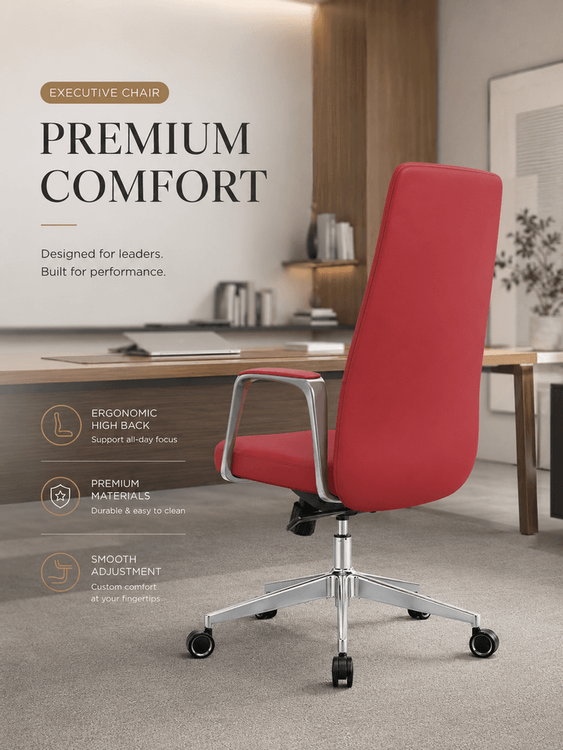
Backrest Support for Office Chairs
The backrest support is the core structural element of an office chair, playing a crucial role in dynamic fitting and mechanical support, especially in ergonomic design. Its design directly affects the chair's comfort, health protection, and user experience. The following sections elaborate on its technical principles, functional characteristics, and typical applications:

1. Technical Principles: Dynamic Support and Mechanical Optimization
The design of backrest supports adheres to ergonomic principles, achieving dynamic alignment with the body's curves through structural innovation. For instance, the full-posture synchronous gliding linkage technology employs a multi-rod linkage mechanism to create a coordinated motion system among the backrest, seat cushion, and armrests. When a user leans back, the backrest's tilt angle and the seat cushion's forward movement are precisely coordinated to prevent lumbar suspension. The single-rod three-segment linkage structure divides the backrest into upper, middle, and lower sections, each independently adjustable to accommodate the spine's natural curvature in various sitting positions. Such designs optimize mechanical structures to evenly distribute body pressure across support nodes, reducing localized pressure.
More advanced lumbar-back gliding dynamic support technology (e.g., the Syncrole system in Sihoo C300 Second Generation Pro) utilizes elastic materials and intelligent tracking algorithms to automatically adjust the lumbar pillow's position based on the user's sitting posture. For example, when a user leans forward for work, the lumbar pillow moves forward to provide additional support; when leaning back for rest, it moves backward to maintain alignment, avoiding lumbar fatigue caused by positional deviations in traditional fixed lumbar supports.
2. Functional Characteristics: Multi-Dimensional Adjustment and Health Protection
The functionality of backrest supports extends to multi-zone coordinated adjustment. Take the four-zone linkage system as an example, which synchronizes the motion of the backrest, lumbar pillow, armrests, and headrest to achieve "human-chair synchronization": when a user turns their body, the armrests adjust their angle to follow the arm's movement, the headrest automatically fits the neck's curve, and the backrest's tilt angle and lumbar support force change simultaneously, forming a comprehensive support loop. Such designs effectively maintain the natural physiological curves of the cervical and lumbar spine, reducing the risk of muscle strain from prolonged sitting.
Moreover, the material selection of backrest supports also influences support performance. High-strength alloy steel frames provide foundational load-bearing capacity, while breathable mesh or memory foam coverings further conform to the body's contours through elastic deformation. For instance, some products use DynaCore dynamic tracking material, which automatically adjusts its hardness based on pressure distribution, enhancing comfort while maintaining support.
3. Typical Applications: Integrated Design in Office Swivel Chairs
In office swivel chairs, backrest supports are deeply integrated with rotation and height adjustment functions. Through adjustable lumbar supports (e.g., height and depth adjustments) and backrest angle locking mechanisms, users can customize support intensity based on their height, body type, and work scenarios. For example, when drawing requires a forward-leaning posture, the lumbar support can be lowered and the backrest locked in a forward-tilting position; during meetings when leaning back for rest, the backrest's tilting function can be released, and lumbar support increased. Such designs enable a single chair to adapt to multiple scenarios, improving space utilization and efficiency.
In conclusion, backrest supports, through structural innovation, material optimization, and functional integration, serve as the core载体 (Note: '载体' here means 'medium' or 'vehicle', but in English, it's better to rephrase for clarity) for realizing ergonomic value in office chairs. Their design must balance mechanical stability with dynamic adaptability to scientifically support user health and work efficiency.